Archive for the ‘Mike’s Rambling’ Category
Turn Up the Heat
Posted by Mike | Filed under Mike's Rambling
OK, I’ve been content to entertain you with my little stories, but I can see you’re a bit farther along in your little handbasket ride than I expected, and you’re so beleaguered with terrible news every day that I thought I’d better explain something in my avuncular, reassuring way that will make you feel better. Or at least keep you quiet for a while so I can get some sleep.
Of all the horror available for your viewing pleasure, Haiti destroyed, Iran getting nukes, terrorists hating us, blah, blah, blah, the one that simply refuses to go away is global warming. Man-made carbon dioxide is running amok. Another species goes extinct every time you flip on a light switch. You drive to work over the screaming bodies of baby polar bears. Every time you exhale you are destroying the planet. Go ahead, listen to your iPod while the sea rises up to your stupid neck. No wonder you’re scared. I’d be scared too if I had that corpulent toad Al Gore screaming in my face with his doughnut-laden breath of doom.
So what I have to say should come as a welcome surprise. No, I’m not going to tell you that climate change isn’t happening; of course it’s happening, as it has been doing for four and a half billion years. In fact we probably are in a warming trend, as we are still recovering from the Pliocene-Quaternary ice age, which started about two and a half million years ago, with the glaciation period ending a mere ten thousand years ago. In between these ice ages the Earth warms up to the point where Greenland, Iceland, and Antarctica are mostly ice-free; obviously we haven’t gotten there yet, but maybe we’ll get lucky and it won’t take much longer.
Now, we can’t take all the credit for the pleasant warming trend, as we only got here about 200,000 years ago, but maybe we are helping it along. My point is, that doesn’t mean we are destroying the planet. We are always talking about destroying the planet. When we invented atom bombs, we rubbed our hands in glee and said, “Now we can destroy the planet!” Now we believe we are doing it with our Hummers. Well let me tell you, Bunky, we aren’t Supermen. We’re like the ant with a boner, floating on its back down the river yelling, “Raise the drawbridge!” We cannot destroy the entire planet (at least not yet.) All we can do is destroy the planet for humans!
You see, that’s the good news! The planet will still be here! We may be able to take the polar bears with us, but there’s no way we’ll snuff out everybody! There are organisms on this planet that thrive at 176°F and higher. I’m sure the cockroaches can take it. Probably when we’re no longer eating everything in sight, whole new life forms will evolve that love the sun and generate their own natural sunblock, with built-in beach chairs growing out of their butts. Just because we’re not here to see it doesn’t mean it won’t be great! I’m sure the new owners will even be smart enough to avoid creating reality TV. Don’t you wish you could be here? Well, get over it; you won’t. But it’ll still be great.
Have a nice day.
Car of the Future!
Posted by Mike | Filed under Mike's Rambling
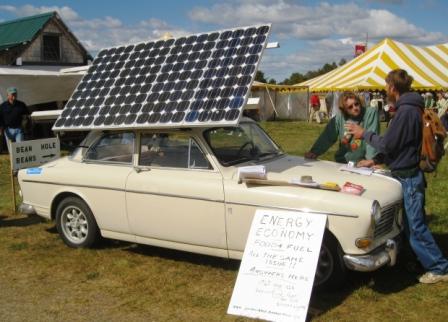
“Sir! Thank you for stopping by! Let me introduce you to the Car of the Future! This is the car that Big Auto and Big Oil don’t want you to know about!”
“But that looks like a 1960s Volvo with a solar panel on top.”
“Very perceptive, sir! Of course, this is just a prototype. With the help of savvy investors such as yourself coming in on the ground floor, we’ll soon be gearing up to produce millions of sleek, efficient and attractive vehicles. The American driving public will beat a path to our door. How can we miss? A gorgeous car that runs for free and defeats global warming?”
“This car runs for free?”
“Well, as I said, this is a prototype. It doesn’t have all the aerodynamics the production model will have. And this solar panel was designed for an RV. It was on sale at Camper World. The actual Car of the Future will have an integrated, high-efficiency solar array that will provide more power than the car will ever need! In fact, we’re working out a way to feed excess current back into the grid. This little beauty will actually be making you money as you drive down the road! Of course, we don’t want Big Electricity to find out about that too soon.”
“But this solar panel helps drive the car?”
“Absolutely, sir! We have no doubt the mileage has been improved tremendously! Of course, it’s an indirect benefit at this point, as we haven’t completed our research on how to install the electric motor and actually hook it to the drive train, but at this point the solar panel provides full power to the radio and the dome light, greatly reducing the drag on the alternator and allowing the engine to do what it was designed for; moving this car effortlessly down America’s highways and byways!”
“That panel sort of sticks up a lot. How is it in the wind?”
“Head winds and tail winds are no problem at all, sir. But until we achieve the integrated solar array, we don’t recommend driving it in crosswinds of greater than 25 miles per hour.”
“I see. Well, how do you keep the panel facing the sun?”
“Excellent question, sir! I can see you have an engineering background. As I’m sure you’ve noticed, the panel is now set up for eastbound driving. When you want to turn around, you simply stop and loosen these two wing nuts, tilt the panel over to the other side, climb back in and Go West, Young Man! Ha-ha!”
“What about going north or south?”
“Well, I admit at this point we haven’t gotten that completely worked out. My Mom has a large lazy susan that she hardly ever uses; if she lets me borrow it, I think we can work out a rotating mount system that will allow driving in a southerly or northerly direction. Of course, the farther north you go, the weaker the sun’s rays, so the car won’t be certified for use in Canada.”
“Hmm. Now what if I want to drive at night?”
“Why would you want to do that? Ha, just kidding, sir. Our research suggests that night driving will require a passenger leaning out the window and shining this large flashlight on the… Sir! Sir, wait a minute! Come back! This is the investment opportunity of a lifetime!”
A Short Flight
Posted by Mike | Filed under Mike's Rambling
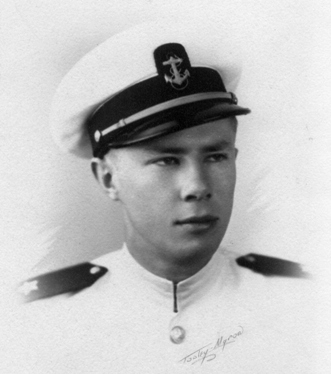
Aboard the aircraft carrier Philippine Sea off the coast of Korea on January 15, 1951, Lieutenant Commander Norman W. “Bill” Frees, Jr., and his two crewmen climbed aboard their Douglas AD-4W “Skyraider” for a morning patrol flight. Originally scheduled for 0400, the launch had been postponed until daybreak due to poor weather and rough seas, a delay that proved to be very much to their advantage. The airplane was moved into position, and the powerful steam catapult accelerated it rapidly down the deck and into the air. The single Wright 18 cylinder radial engine, producing 2700 horsepower at full throttle, pulled the aircraft up to an altitude of about 500 feet when suddenly the power unexpectedly dropped back to an idle. The plane was going down.
The AD-4W is a modified version of the AD-4 dive bomber, redesigned for airborne early warning (AEW) missions. While the dive bomber carried only the pilot, the AEW version of the plane added two crew members for radar and radio operations in a lower compartment. It had a range of 1100 miles, a top speed of 350 miles per hour and a ceiling of 26,000 feet. Normal flying weight was 17,500 pounds, but it could carry a maximum weight of 24,000 pounds. The pilots were told that the dive bomber version of this single engine carrier-based plane could carry a greater bomb load than the four engine B-17 bombers used in World War II.
The AD-4Ws replaced the TBM Avengers that Bill Frees had flown in the Pacific during WWII. He found the plane to be much more maneuverable and lighter on the controls than the Avenger. This one, however, had transformed itself from a powerful aircraft to a woefully inadequate glider. Reflecting later on what happened, he has always imagined some small cotter pin or other fastener breaking loose in the throttle linkage, a 25 cent part bringing down a two million dollar airplane.
Bill had never ditched a plane in the ocean before, but he’d had plenty of experience in tight situations during his career. He had earned two Distinguished Flying Crosses and an Air Medal during the Pacific campaign, and had gained the confidence of his crew members at that time, who elected to go with him when he was transferred to a hazardous night torpedo squadron during the latter part of the war.
He quickly radioed a Mayday back to the carrier, and instructed his crew to prepare for a ditching. The waves below him were 15 to 20 feet high, “making a water landing somewhat more tricky” (his words.) He was able to line up into the wind and make a fairly smooth landing on the top of a wave, sliding down into the trough. This allowed the plane to float for a while, giving the men time to climb out on the wing and inflate their individual life rafts, stored under their parachutes.
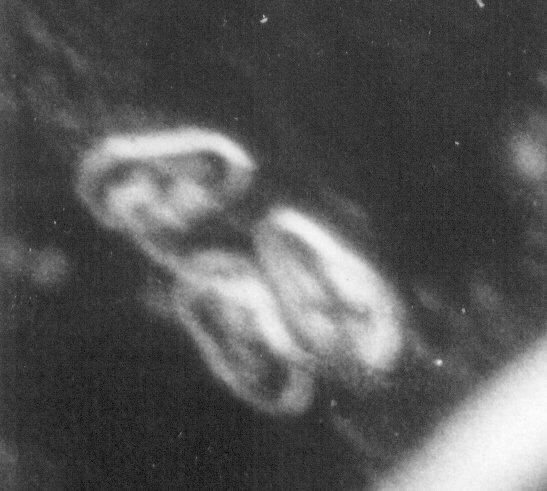
In January, the waters off the Korean peninsula become very cold. It was estimated that an unprotected pilot would succumb to hypothermia within 20 minutes. All air crew members wore rubber survival suits (given the inelegant nickname “poopy suits”) under their flight gear. The rescue helicopter was over the three fliers quickly. One of the crewmen had forgotten to tighten up the neck opening of his survival suit and was already starting to suffer from the cold, so Bill requested that he be picked up first. Shortly after he was lifted from the water, a destroyer came alongside to pick up Bill and the remaining crewman.
Bill always remembered the words of the destroyer captain’s remark as he came aboard. Not, “are you OK?” but “How about surveying your .38 pistol?” He was more interested in getting Bill’s sidearm than in any rescue. The men were quickly transferred back to the Philippine Sea for a hot shower and a shot of brandy.